Threshold T50 Class A Amplifier - 50 Watts
General:
The T-50 is an interesting amplifier in the Threshold range, delivering pure Class A operation with 50 watts into 8 ohms and 100 watts into 4 ohms.
It came later than the more famous Stasis series, representing a shift in design philosophy away from hybrid topologies toward a more minimalist, purist approach. Rather than combining a Class A front end with a high-power output stage, the T-50 operates fully in Class A,
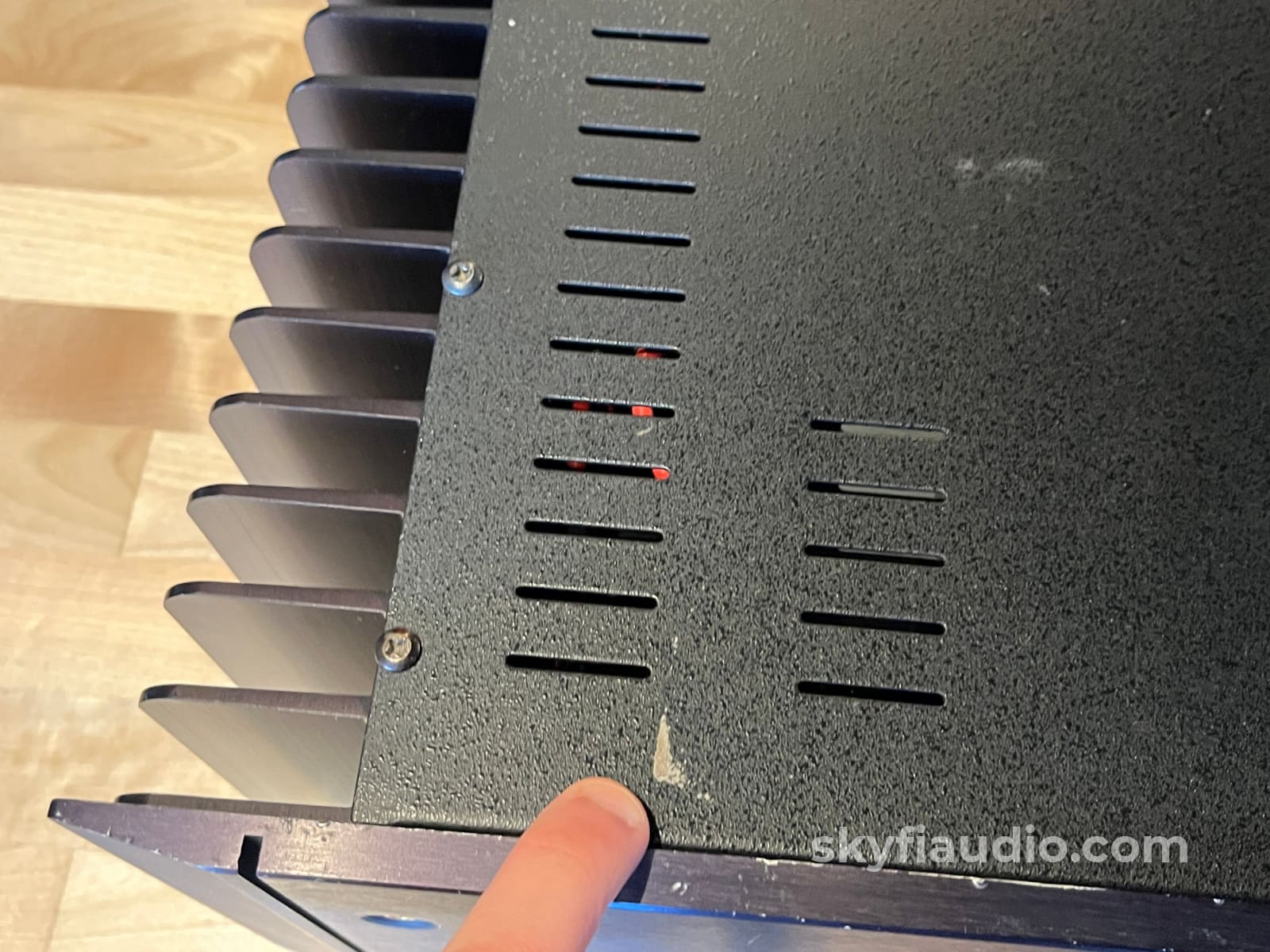
The result is an excellent sound with typical class A smoothness, musicality (and heat). We really enjoyed the way this amplifier sounded at our test rig.
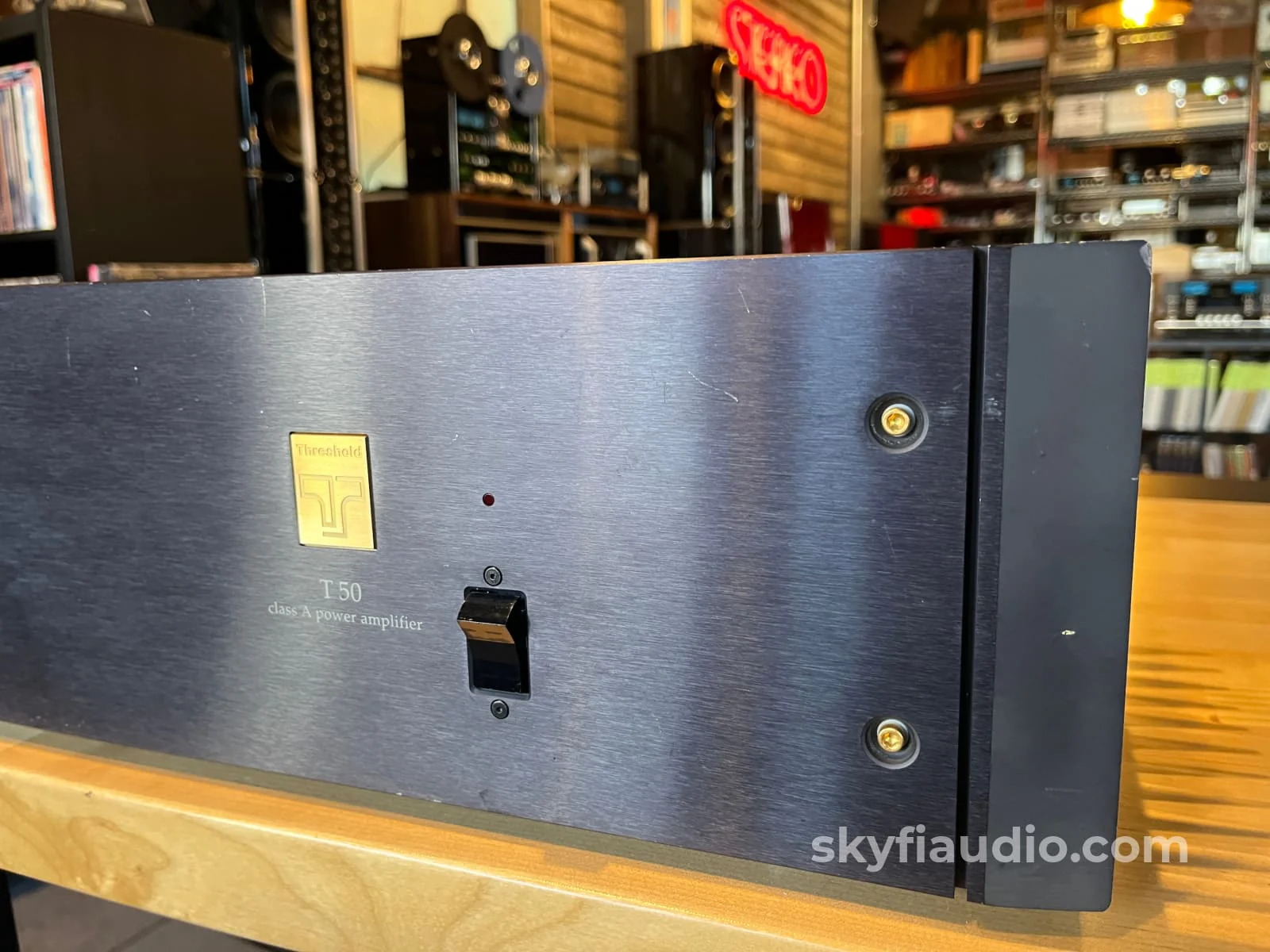
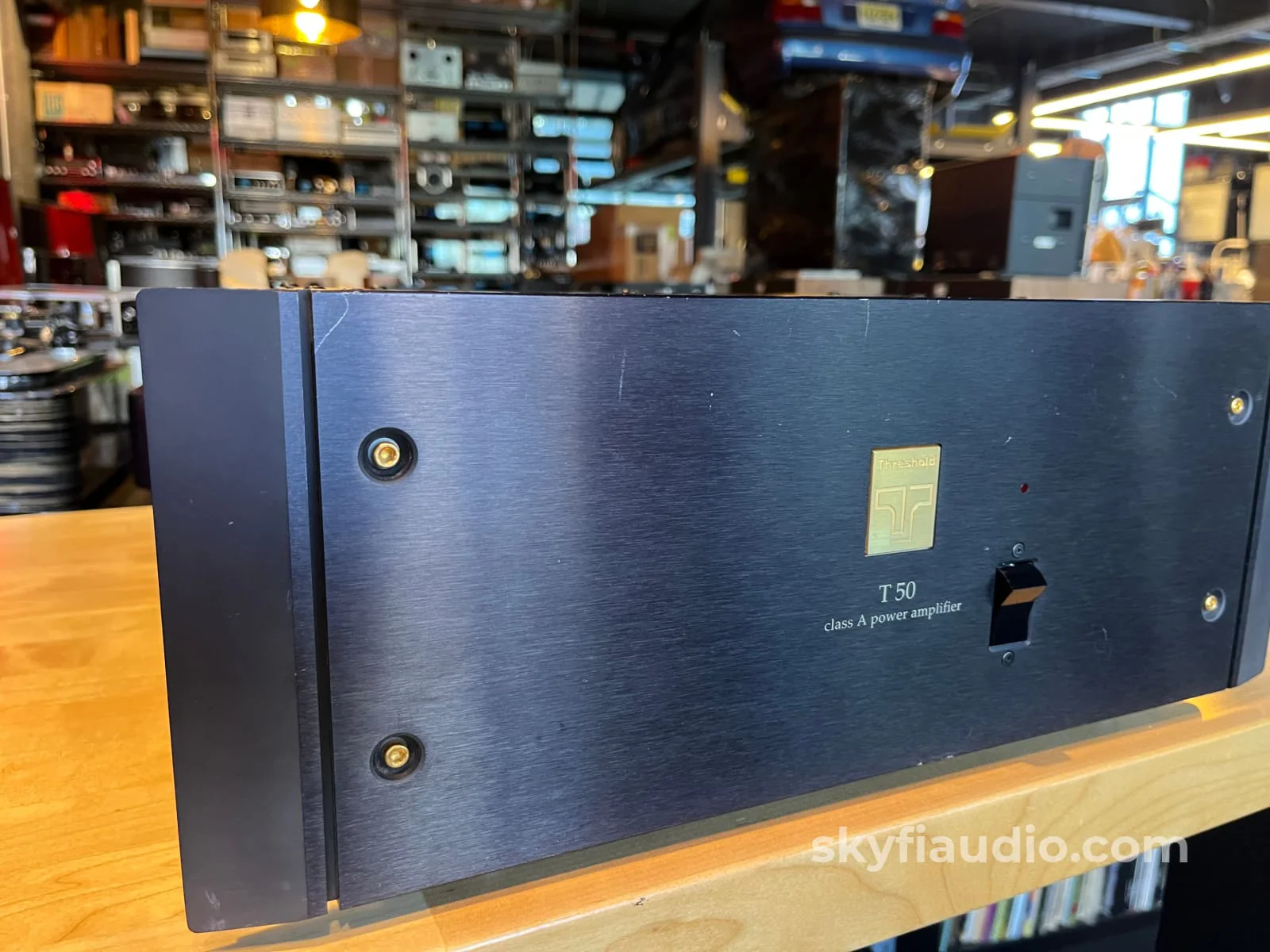
In addition to its sound we also like its compact chassis and overall design, It can fit on narrow shelfs that other class A amplifiers cannot.
SkyFi Cosmetic Notes:
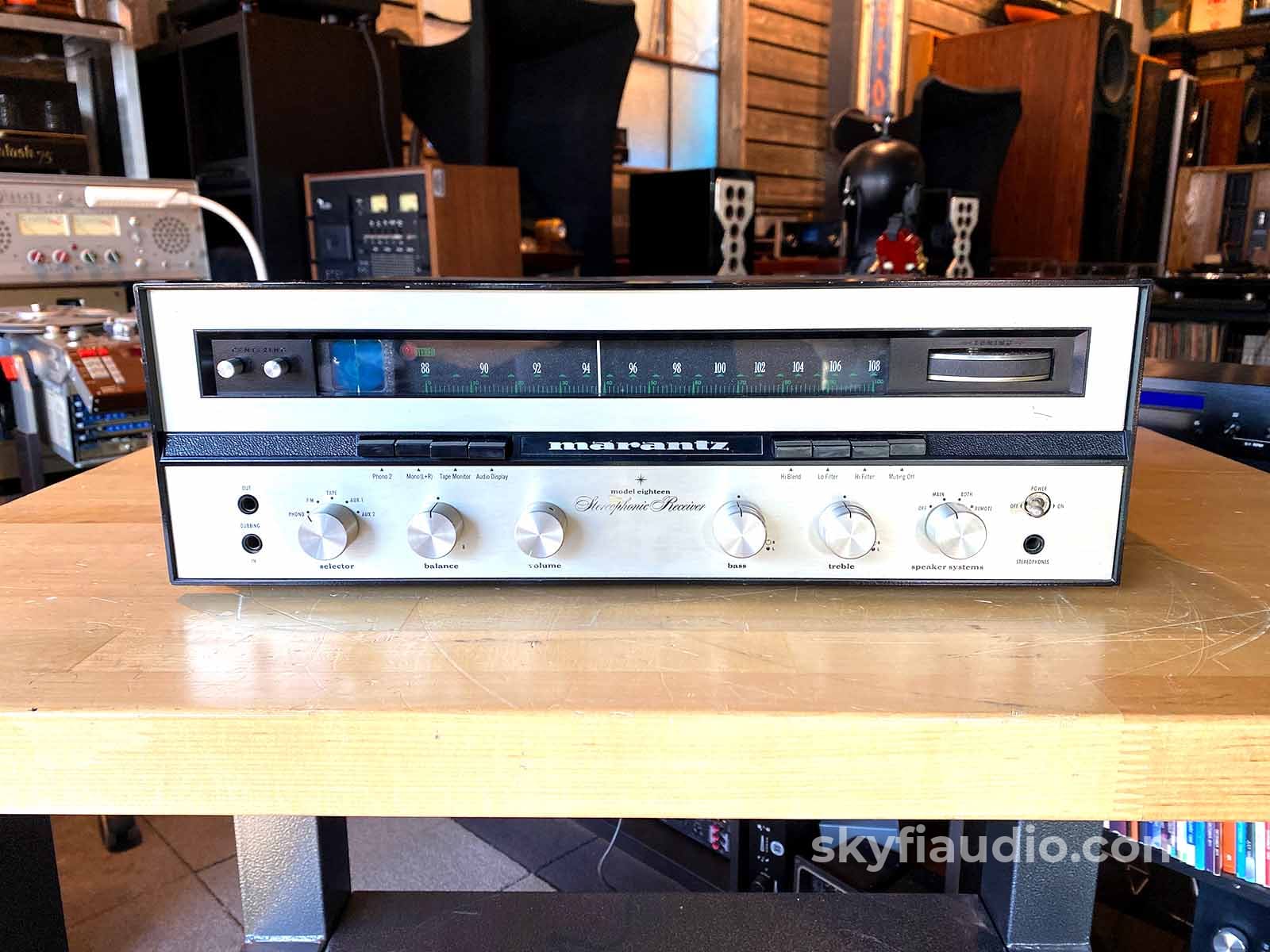
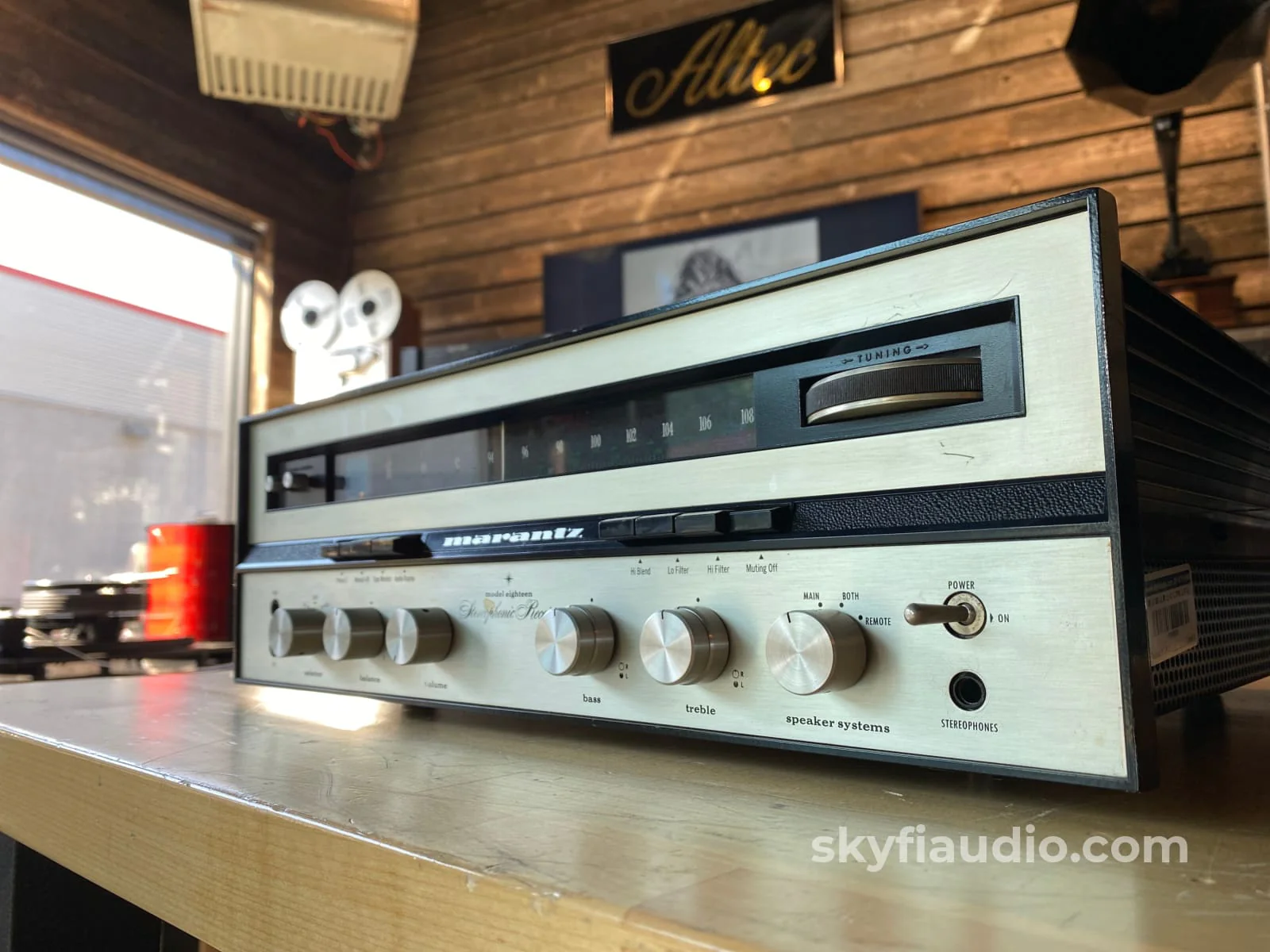
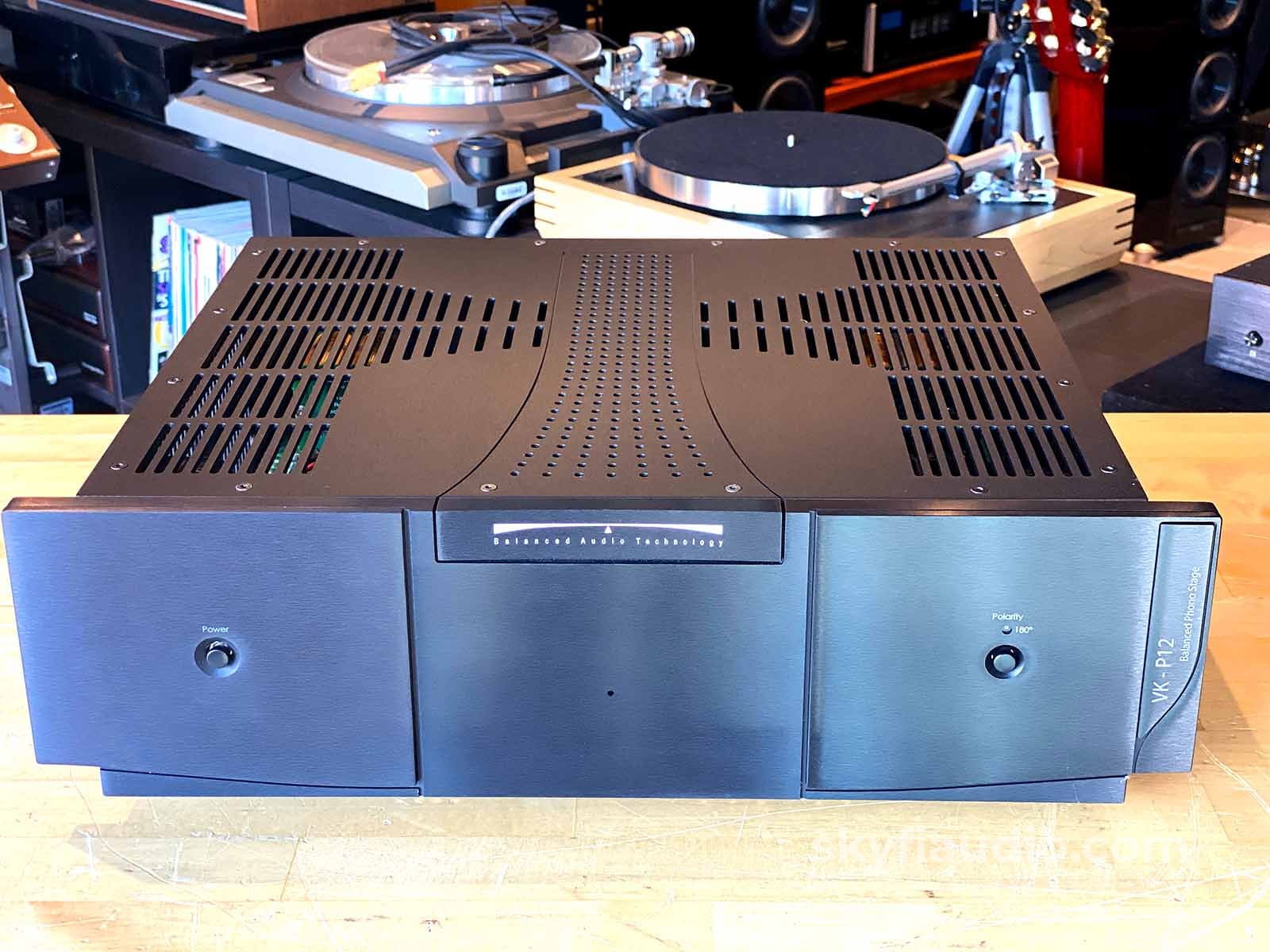
Faceplate wear is present. All other surfaces also show wear. Overall the condition is presentable.
SkyFi Technical Notes:
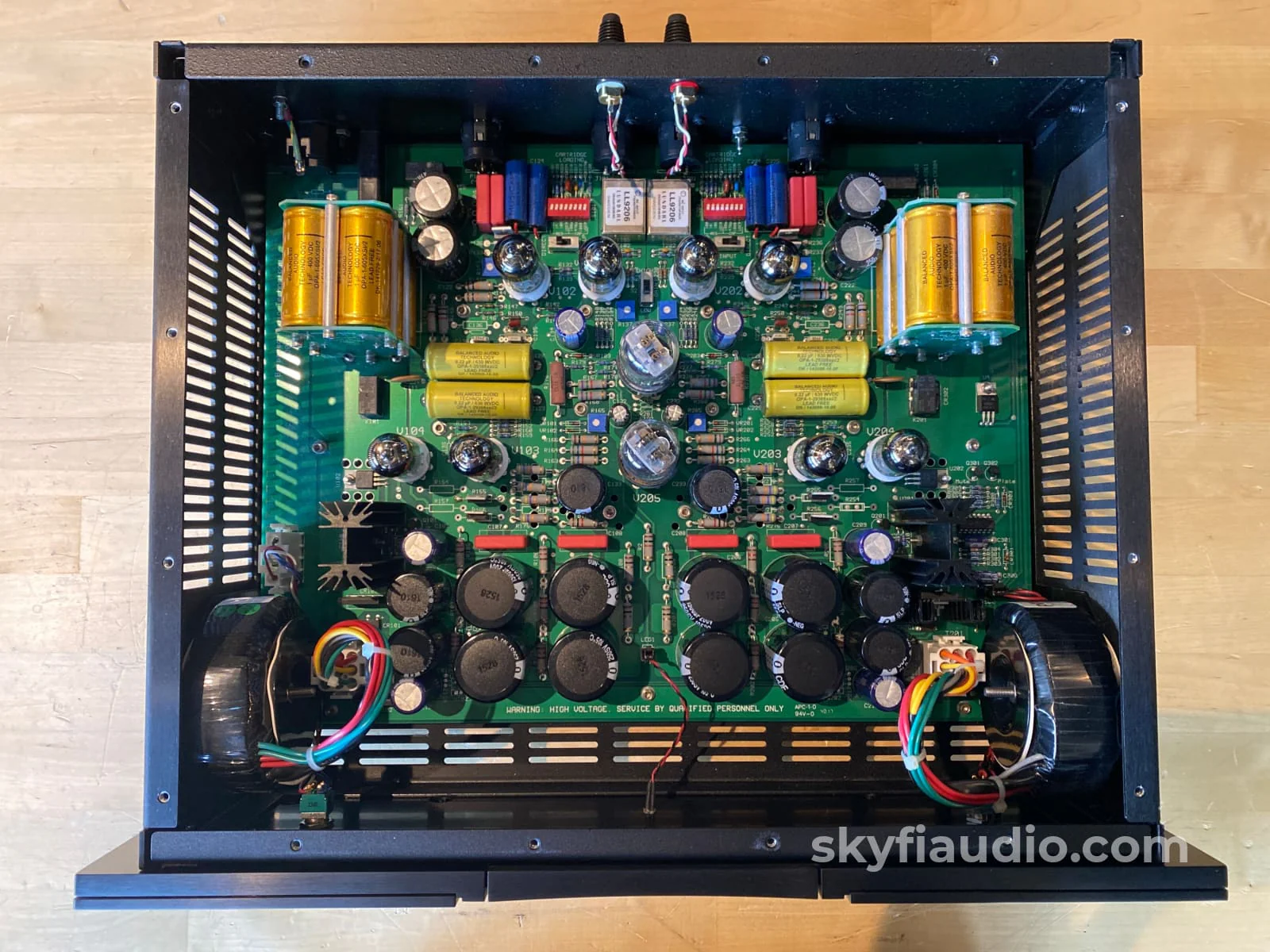
This amplifier came in with a bad single ended / balanced switch on the left channel. We replaced the defective switch and set the DC offset and Bias. While we had the unit on the bench we noticed that the right channel appears to have been serviced at some point in the past.
Ownership:
Second Owner
Connections:
RCA, XLR, IEC Power
General Sound:
Smooth, uncolored, undistorted natural and clean
Cosmetic Condition:
6/10 = Fair. Three to four minor scratches, or one major scratch. See our detailed rating description here.
Working Condition:
Working perfectly and tested in our lab and listening room.
Included:
Just the unit and power cord.
Packing:
Will be packed using our highly developed in-house process and custom packing materials.Specs:
- Power Output: 50 Watts per channel into 8 ohms (Pure Class A).
- Design: Bipolar output transistors (8 per channel).
- Transformer: 500 VA Transformer.
- Frequency Response: 20 Hz – 20 kHz, ±0.1 dB.
- Voltage Gain: 26.8 dB.
- Input Impedance: 100k ohms balanced, 50k ohms single-ended.
- Damping Factor: >800, 20 Hz – 20 kHz into 8 ohms.
- Signal to Noise Ratio: >80 dB (ref. 1W).
Dimensions:
Height: 50mm (1.97 inches) Width: 400mm (15.75 inches) Length: 1140mm (44.88 inches)
Weight:
45 lbs.
Approximate Age:
1994
Recommended Cables:
Kimber Kable - RCA Interconnects - Better
Kimber Kable - RCA Interconnects - Best
Kimber Kable - BALANCED XLR Connectors - Better
Kimber Kable - BALANCED XLR Connectors - Best
Kimber Kable - Speaker Cables - Better
Kimber Summit Series Monocle XL Speaker Cables (PAIR) - Best
Kimber Summit Series BiFocal XL Bi-Wire Speaker Cables (PAIR) - Best If Applicable
Kimber Kable - Power Cords - Better
Kimber Kable - Power Cords - Best
Testing Process:
We start with a visual inspection of all internal components to make sure that there are no signs of heat stress or damage. Capacitors are checked for telltale signs of predictive failure including bulging, shrunken wrappers, or physical leakage. We also inspect the PCBs for discoloration from resistors or transistors that may have been running hot. On vintage units we often spot check select capacitors for value and ESR.
If the amplifier passes visual inspection, we move on to a controlled power on sequence using a Sencore safety analyzer to monitor current draw in real time. Once the amplifier is determined to be safe to operate, we connect it to full AC mains for function and power testing. We connect the speaker outputs of the amplifier to a Sencore PA81 Power Analyzer which acts as a dummy load, DC offset monitor, and oscilloscope interface. We start with a low level 1 KHz test signal at the amplifier's input and slowly increase its amplitude while monitoring the output on an oscilloscope for signs of noise, clipping, distortion, or improper channel balance. We continue increasing the signal level until the amplifier reaches clipping.
At this point we take an output power measurement and compare it to the spec sheet of the amplifier to verify proper performance. If the device under test has both balanced and single ended inputs they are both tested at this time.
We finish off the bench evaluation with a 1 KHz square wave check and a 20 Hz to 20 KHz sine sweep to assess the amplifier's frequency response characteristics.
This battery of tests will usually reveal if the amplifier has any issues that need further attention.
Before the device leaves the bench, we perform a listening test with actual music using a variety of preferred test tracks. Our benches are outfitted with familiar monitor speakers which help us identify inconsistencies that will not always show up on our test gear. The main things that we are listening for are hum or noise with no signal present, proper center image, clicks, pops, or any other obvious undesirable audio characteristics.
If the unit passes all of these tests it is moved to our long term testing rig where we simulate real word operating conditions for 6-8 hours minimum. This allows us to monitor the unit for signs of thermal runaway or intermittent issues that only crop up when the unit has fully come up to temperature.
Original: $2,490.00
-65%$2,490.00
$871.50More Images




Threshold T50 Class A Amplifier - 50 Watts
General:
The T-50 is an interesting amplifier in the Threshold range, delivering pure Class A operation with 50 watts into 8 ohms and 100 watts into 4 ohms.
It came later than the more famous Stasis series, representing a shift in design philosophy away from hybrid topologies toward a more minimalist, purist approach. Rather than combining a Class A front end with a high-power output stage, the T-50 operates fully in Class A,
The result is an excellent sound with typical class A smoothness, musicality (and heat). We really enjoyed the way this amplifier sounded at our test rig.
In addition to its sound we also like its compact chassis and overall design, It can fit on narrow shelfs that other class A amplifiers cannot.
SkyFi Cosmetic Notes:
Faceplate wear is present. All other surfaces also show wear. Overall the condition is presentable.
SkyFi Technical Notes:
This amplifier came in with a bad single ended / balanced switch on the left channel. We replaced the defective switch and set the DC offset and Bias. While we had the unit on the bench we noticed that the right channel appears to have been serviced at some point in the past.
Ownership:
Second Owner
Connections:
RCA, XLR, IEC Power
General Sound:
Smooth, uncolored, undistorted natural and clean
Cosmetic Condition:
6/10 = Fair. Three to four minor scratches, or one major scratch. See our detailed rating description here.
Working Condition:
Working perfectly and tested in our lab and listening room.
Included:
Just the unit and power cord.
Packing:
Will be packed using our highly developed in-house process and custom packing materials.Specs:
- Power Output: 50 Watts per channel into 8 ohms (Pure Class A).
- Design: Bipolar output transistors (8 per channel).
- Transformer: 500 VA Transformer.
- Frequency Response: 20 Hz – 20 kHz, ±0.1 dB.
- Voltage Gain: 26.8 dB.
- Input Impedance: 100k ohms balanced, 50k ohms single-ended.
- Damping Factor: >800, 20 Hz – 20 kHz into 8 ohms.
- Signal to Noise Ratio: >80 dB (ref. 1W).
Dimensions:
Height: 50mm (1.97 inches) Width: 400mm (15.75 inches) Length: 1140mm (44.88 inches)
Weight:
45 lbs.
Approximate Age:
1994
Recommended Cables:
Kimber Kable - RCA Interconnects - Better
Kimber Kable - RCA Interconnects - Best
Kimber Kable - BALANCED XLR Connectors - Better
Kimber Kable - BALANCED XLR Connectors - Best
Kimber Kable - Speaker Cables - Better
Kimber Summit Series Monocle XL Speaker Cables (PAIR) - Best
Kimber Summit Series BiFocal XL Bi-Wire Speaker Cables (PAIR) - Best If Applicable
Kimber Kable - Power Cords - Better
Kimber Kable - Power Cords - Best
Testing Process:
We start with a visual inspection of all internal components to make sure that there are no signs of heat stress or damage. Capacitors are checked for telltale signs of predictive failure including bulging, shrunken wrappers, or physical leakage. We also inspect the PCBs for discoloration from resistors or transistors that may have been running hot. On vintage units we often spot check select capacitors for value and ESR.
If the amplifier passes visual inspection, we move on to a controlled power on sequence using a Sencore safety analyzer to monitor current draw in real time. Once the amplifier is determined to be safe to operate, we connect it to full AC mains for function and power testing. We connect the speaker outputs of the amplifier to a Sencore PA81 Power Analyzer which acts as a dummy load, DC offset monitor, and oscilloscope interface. We start with a low level 1 KHz test signal at the amplifier's input and slowly increase its amplitude while monitoring the output on an oscilloscope for signs of noise, clipping, distortion, or improper channel balance. We continue increasing the signal level until the amplifier reaches clipping.
At this point we take an output power measurement and compare it to the spec sheet of the amplifier to verify proper performance. If the device under test has both balanced and single ended inputs they are both tested at this time.
We finish off the bench evaluation with a 1 KHz square wave check and a 20 Hz to 20 KHz sine sweep to assess the amplifier's frequency response characteristics.
This battery of tests will usually reveal if the amplifier has any issues that need further attention.
Before the device leaves the bench, we perform a listening test with actual music using a variety of preferred test tracks. Our benches are outfitted with familiar monitor speakers which help us identify inconsistencies that will not always show up on our test gear. The main things that we are listening for are hum or noise with no signal present, proper center image, clicks, pops, or any other obvious undesirable audio characteristics.
If the unit passes all of these tests it is moved to our long term testing rig where we simulate real word operating conditions for 6-8 hours minimum. This allows us to monitor the unit for signs of thermal runaway or intermittent issues that only crop up when the unit has fully come up to temperature.
Product Information
Product Information
Shipping & Returns
Shipping & Returns
Description
General:
The T-50 is an interesting amplifier in the Threshold range, delivering pure Class A operation with 50 watts into 8 ohms and 100 watts into 4 ohms.
It came later than the more famous Stasis series, representing a shift in design philosophy away from hybrid topologies toward a more minimalist, purist approach. Rather than combining a Class A front end with a high-power output stage, the T-50 operates fully in Class A,
The result is an excellent sound with typical class A smoothness, musicality (and heat). We really enjoyed the way this amplifier sounded at our test rig.
In addition to its sound we also like its compact chassis and overall design, It can fit on narrow shelfs that other class A amplifiers cannot.
SkyFi Cosmetic Notes:
Faceplate wear is present. All other surfaces also show wear. Overall the condition is presentable.
SkyFi Technical Notes:
This amplifier came in with a bad single ended / balanced switch on the left channel. We replaced the defective switch and set the DC offset and Bias. While we had the unit on the bench we noticed that the right channel appears to have been serviced at some point in the past.
Ownership:
Second Owner
Connections:
RCA, XLR, IEC Power
General Sound:
Smooth, uncolored, undistorted natural and clean
Cosmetic Condition:
6/10 = Fair. Three to four minor scratches, or one major scratch. See our detailed rating description here.
Working Condition:
Working perfectly and tested in our lab and listening room.
Included:
Just the unit and power cord.
Packing:
Will be packed using our highly developed in-house process and custom packing materials.Specs:
- Power Output: 50 Watts per channel into 8 ohms (Pure Class A).
- Design: Bipolar output transistors (8 per channel).
- Transformer: 500 VA Transformer.
- Frequency Response: 20 Hz – 20 kHz, ±0.1 dB.
- Voltage Gain: 26.8 dB.
- Input Impedance: 100k ohms balanced, 50k ohms single-ended.
- Damping Factor: >800, 20 Hz – 20 kHz into 8 ohms.
- Signal to Noise Ratio: >80 dB (ref. 1W).
Dimensions:
Height: 50mm (1.97 inches) Width: 400mm (15.75 inches) Length: 1140mm (44.88 inches)
Weight:
45 lbs.
Approximate Age:
1994
Recommended Cables:
Kimber Kable - RCA Interconnects - Better
Kimber Kable - RCA Interconnects - Best
Kimber Kable - BALANCED XLR Connectors - Better
Kimber Kable - BALANCED XLR Connectors - Best
Kimber Kable - Speaker Cables - Better
Kimber Summit Series Monocle XL Speaker Cables (PAIR) - Best
Kimber Summit Series BiFocal XL Bi-Wire Speaker Cables (PAIR) - Best If Applicable
Kimber Kable - Power Cords - Better
Kimber Kable - Power Cords - Best
Testing Process:
We start with a visual inspection of all internal components to make sure that there are no signs of heat stress or damage. Capacitors are checked for telltale signs of predictive failure including bulging, shrunken wrappers, or physical leakage. We also inspect the PCBs for discoloration from resistors or transistors that may have been running hot. On vintage units we often spot check select capacitors for value and ESR.
If the amplifier passes visual inspection, we move on to a controlled power on sequence using a Sencore safety analyzer to monitor current draw in real time. Once the amplifier is determined to be safe to operate, we connect it to full AC mains for function and power testing. We connect the speaker outputs of the amplifier to a Sencore PA81 Power Analyzer which acts as a dummy load, DC offset monitor, and oscilloscope interface. We start with a low level 1 KHz test signal at the amplifier's input and slowly increase its amplitude while monitoring the output on an oscilloscope for signs of noise, clipping, distortion, or improper channel balance. We continue increasing the signal level until the amplifier reaches clipping.
At this point we take an output power measurement and compare it to the spec sheet of the amplifier to verify proper performance. If the device under test has both balanced and single ended inputs they are both tested at this time.
We finish off the bench evaluation with a 1 KHz square wave check and a 20 Hz to 20 KHz sine sweep to assess the amplifier's frequency response characteristics.
This battery of tests will usually reveal if the amplifier has any issues that need further attention.
Before the device leaves the bench, we perform a listening test with actual music using a variety of preferred test tracks. Our benches are outfitted with familiar monitor speakers which help us identify inconsistencies that will not always show up on our test gear. The main things that we are listening for are hum or noise with no signal present, proper center image, clicks, pops, or any other obvious undesirable audio characteristics.
If the unit passes all of these tests it is moved to our long term testing rig where we simulate real word operating conditions for 6-8 hours minimum. This allows us to monitor the unit for signs of thermal runaway or intermittent issues that only crop up when the unit has fully come up to temperature.